
Natick City Directory Collections
Natick's historical shelf is strongest when printed directories, resident lists, and companion records are treated as separate series. The Natick Historical Society genealogy resource identifies local runs directly, including its List of Residents for 1850-2019 and a 1965 Resident and Business Directory. It also points researchers to a digitized 1911 directory and to yearbooks, newspapers, census sources, and local archival material. Exact continuity for a local printed city-directory run has not been published, so no uninterrupted series should be assumed.
| Collection | Years or editions | Where held | Access |
|---|---|---|---|
| Natick List of Residents | 1850-2019 | Natick Historical Society Research Library and Archive | On-site resident-list evidence; annual or periodic coverage may vary. |
| Natick Resident and Business Directory | 1965 | Natick Historical Society | On-site printed source for names, addresses, or business context. |
| Lakeview Press Resident and Business Directory | 1911 | Internet Archive, FamilySearch, and Historical Society references | Digitized item; open the item from Historical Society links before relying on a page. |
| Ridley's Directory of Natick | 1873 | FamilySearch and other genealogy catalogues | Established genealogy-database access varies by item. |
| Catalogued Natick editions | 1900, 1905, 1908, 1909, 1911, 1913, 1915, 1917, 1920, 1923, 1931 | FamilySearch, archive collections, and State or Boston-area catalogues | Subscription or library access may vary; verify the edition image. |
| Valuation and resident material | Circa 1892 | Natick Historical Society house-history resources | Local bridge between deeds, census, and directory records. |
The table is a map of documented holdings, not a claim that every year is online. The Historical Society reports a clear resident-list span, while its library information does not establish a continuous city-directory publisher run. A catalogue result is a lead to an edition, not a substitute for inspecting that edition's title page and entries.
Note: Preserve the edition year and repository with each name because a directory entry is dated evidence, not a current address.
Natick City Directory Years in Print
Natick's verified directory history includes a small but useful set of anchors. Ridley's Directory of Natick appears in 1873. Lakeview Press issued the 1911 Resident and Business Directory. The Historical Society holds the 1965 Resident and Business Directory, while online and catalogue findings identify selected editions from 1900 through 1931. These points are enough to build a careful timeline, but the first or last continuous Natick city-directory year and a complete publisher sequence remain unverified.
- 1873: Ridley's Directory of Natick is a documented early directory lead.
- 1911: Lakeview Press publishes a resident, street, and business directory with civic and statistical material.
- 1965: The Natick Historical Society identifies its Resident and Business Directory as an on-site printed source.
- 1850-2019: The Historical Society's List of Residents provides a different local series across a much longer span.
Printed coverage is only one local record layer. Natick's annual town reports begin in 1850 in Historical Society and Morse materials, with 1850-2020 reports searchable in the Morse Internet Archive collection according to the library's 2024 trustee report. Those reports can add officers, departments, petitioners, projects, and annual civic context when a city directory year is absent.
Natick City Directories at Local Desks
The Natick Historical Society archive is the most specific local research channel. Its research library and archive are at 58 Eliot Street, and the society lists winter hours of Tuesday and Thursday from 10 to 4, with Wednesday by appointment. Seasonal hours can change. It accepts research requests and offers starting points, but says it cannot conduct extensive research for individuals. A focused request should name the person, address, date range, and collection sought.
The Historical Society's archival-collections page shows the type of local family, civic, veterans', and business holdings that support a directory search.
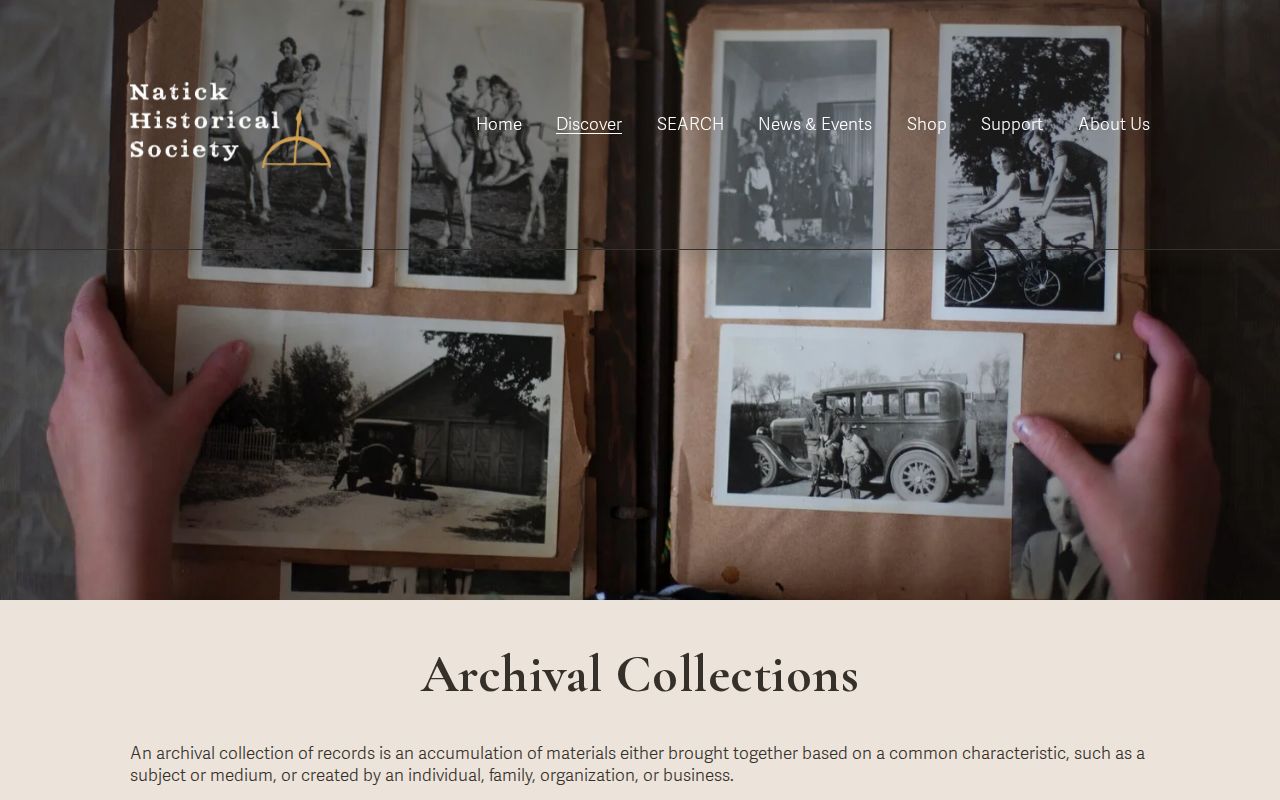
These collections can add letters, photographs, clippings, maps, and organizational material to a name found in a volume. They do not turn a directory entry into proof of every household connection. Morse Institute Library is another downtown research channel with local-history information, public computers, licensed databases, and local newspaper access. Its card-based resources can have different on-site and at-home rules, so confirm access before planning a search.
The 1911 Natick City Directory
Lakeview Press's 1911 volume is more than an alphabetical name list. Its full title identifies a complete resident, street, and business directory, then adds town officers, schools, societies, churches, post offices, tax rate and valuation, and 1910 census figures. That breadth makes the book a snapshot of both people and the civic setting around them. The actual item is linked from Historical Society genealogy material and is also described through Internet Archive and FamilySearch references.
The Historical Society's genealogy page is the responsible starting link for the digitized directory and related Natick collections.
The 1911 book's street section can help test a location against an alphabetical result for that edition. It still has edition-level limits. The page images were not available to the research crawler for a verified punctuation or abbreviation-key transcription, so read the volume's own preliminary material before assigning meaning to initials, symbols, or household marks.
Note: Use the 1911 title page and its own key before expanding any shortened name, address, or relationship mark.
Reading a Natick City Directory Entry
Start with what the particular page visibly says. Research confirms the 1911 title and its resident, street, and business sections, but it does not confirm a standardized Natick abbreviation key, an owner symbol, or exact page punctuation. Early directory conventions often emphasize heads of household, list married women under a husband's name, and include an address and occupation or business detail. Those are common historical conventions, not a guarantee for every Natick edition.
| Entry element | How to read it |
|---|---|
| Name | Record the spelling, initials, and any relationship wording exactly as printed. |
| Address | Copy the house number and street, then check whether the same edition has a street section. |
| Occupation or business clue | Use it to distinguish similarly named people, then verify it with another dated source. |
| Directory classification | Note whether the item appears in resident, business, or street material rather than treating all entries alike. |
| Edition and page | Keep the year, publisher, page image, and repository with the transcription. |
- Criss-cross directory
- An address- or street-ordered directory that reverses the usual alphabetical lookup. Natick's 1911 title confirms a street section, but a later local reverse run is not verified.
- Householder index
- An index organized around a household name. It may leave out other people at the address, depending on the publication.
- Abbreviation key
- A volume's own guide to shortened terms. Photograph or transcribe it from that specific book before interpreting a mark.
If an abbreviation, relationship mark, or address formatting is unclear, leave it as a transcription question until the original volume resolves it. That restraint matters when the same surname appears in several Natick city-directory entries.
Natick City Directory Companions
Natick Historical Society sources give several ways to test a city-directory finding. Its local holdings include assessor reports and real-estate evaluations for 1854-2011, Massachusetts state census material for Natick in 1855 and 1865, and historic vital material. Morse has digitized local newspapers from 1856-1974, while Library of Congress coverage identifies local newspapers from 1848 forward. An obituary, marriage notice, deed, valuation list, or town report can explain why a person appears, moves, or disappears between directory dates.
School sources are especially useful for reconnecting with former classmates and placing a family in a time period. Natick High School yearbooks are available online for 1916-1950, and the Historical Society reports holdings through 1994. Attendance records cover 1885-1945. These materials can supply names, photographs, class year, and school context, but a yearbook address or class appearance should not be treated as a current location.
Trace Families Through Natick City Directories
A family-history trail works best when every step is tied to a date. Begin with one edition that plausibly matches the person, transcribe the entry, and then check the street section if the volume has one. Follow the same name across nearby available editions, but do not treat an absence as a final answer. A person may be omitted, listed under another name, living in another household, temporarily away, or missed by optical-character-recognition search.
- Find the person in one documented Natick edition and record the exact name, address, business or occupation clue, page, and repository.
- Check the same edition's street section, if present, to see whether the address produces another dated clue.
- Compare available editions before and after the apparent move, trying initials, spelling variants, and married or maiden names where relevant.
- Pair the directory period with the 1855 or 1865 Massachusetts census, or with released federal census schedules for the appropriate year.
- Use a newspaper, vital record, probate file, valuation list, or deed to explain a move, death, estate, or ownership change.
Federal census schedules follow the 72-year release rule. The research identifies 1940 and 1950 as public, while later schedules remain closed as of 2026. Probate, deed, and vital sources have their own access rules. An address clue in a directory should be verified in the source that best fits the question before it becomes part of a family conclusion.
Note: Pairing an edition with a census year can separate a published address clue from a household relationship record.
Natick City Directory Gaps
Gaps deserve to be named rather than filled with guesses. The Historical Society reports vital records online to 1850 and printed local material to 1953, with an 1851-1873 gap. It identifies many directory and resident-list sources, but the exact continuous city-directory run is not documented. The 1874 Natick Center fire destroyed downtown business blocks, shoe factories, Town Hall, the fire engine house, a church, and homes. It may explain some reconstructed or missing municipal context, but no verified inventory establishes which specific record books were lost.
When a search reaches a gap, shift channels. Ask the Historical Society or Morse reference staff for the named edition, resident list, newspaper, map, or town report; use the U.S. City and Business Directories collection to seek a catalogued digitized item; then confirm a promising result in the image or at the repository. For a current parcel or deed question, use the address-focused Natick street directory route rather than trying to make an old volume answer a modern ownership question.